
News Center
News center

New EPD Report Requirements in China’s Pump Export Certification Regulations
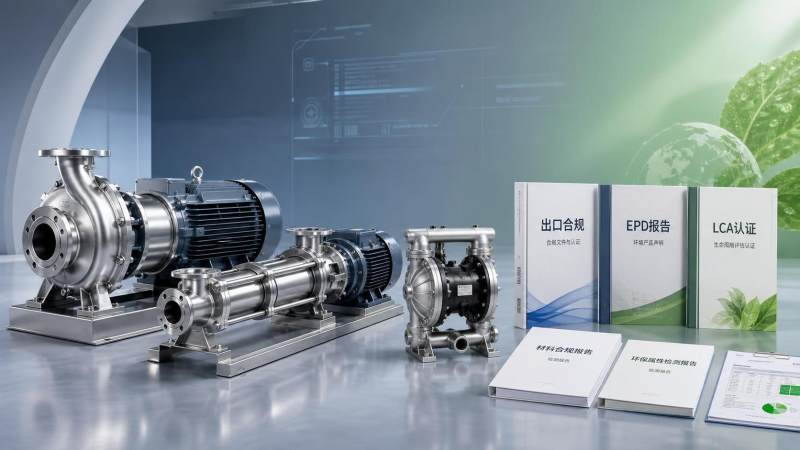
According to the information provided in this update, starting August 15, 2026, when exporting pumps and other pump equipment from China to markets such as the European Union where green trade barriers are becoming increasingly stringent, exporters will be required to submit an Environmental Product Declaration (EPD) report certified through LCA, in addition to the existing CE certification and energy efficiency test report. The implementation guidelines that have been disclosed were jointly issued by the National Certification and Accreditation Administration and the China General Machinery Industry Association to key exporting enterprises, covering the full range of products, including centrifugal pumps, screw pumps, and diaphragm pumps.
For exporting enterprises, this means that the relevant compliance requirements have extended beyond traditional safety and performance considerations to include product environmental information disclosure. Based on the information currently available, the most direct impact of this change will be on customs clearance and delivery. The summary clearly states that missing compliance documents may result in customs clearance delays, returned shipments, or rejection by importers. For pump export businesses centered on project delivery, order cycles, and acceptance by overseas customers, the completeness of certification materials is no longer merely a matter of customs declaration procedures; it may also affect contract execution schedules and customer relationship management. Particularly in markets where green trade requirements continue to tighten, EPD reports are likely to become one of the prerequisites for buyers when reviewing suppliers.
What Signal Does the New Requirement Send?
The core of this requirement is not simply the addition of another document. Rather, it reflects the growing attention in export markets to the transparency of the environmental footprints of manufactured products. The fact that EPD reports and LCA certification are included in the requirements at the same time indicates that the relevant markets are placing greater emphasis on how a product's environmental performance is presented from a life-cycle perspective, rather than focusing only on end-use energy efficiency or the results of a single test. For industrial products such as pumps, future export compliance competition may depend not only on whether products meet technical thresholds, but also on whether enterprises can consistently provide verifiable environmental data materials that align with international procurement practices.
This also means that pump manufacturers are facing a structural change in export entry requirements. In the past, companies primarily prepared documentation around product certifications. Going forward, they may need to further connect the information chains linking R&D, manufacturing, testing, certification, and foreign trade delivery. Companies that establish internal documentation preparation mechanisms earlier may be better positioned to handle orders and communicate with customers.
The Impact Extends Beyond the Certification Department
At first glance, the new rules primarily affect foreign trade, certification, and customs declaration positions. In practice, however, their impact will be broader. Since EPD reports involve environmental product declarations, multiple internal processes related to product documentation, process information, testing coordination, and externally submitted documents may be incorporated into a coordinated workflow. For enterprises that previously relied on existing certification systems to support exports, the additional requirements may lead to longer document preparation cycles, additional internal review procedures, and adjustments to the way information is communicated to customers.
It is particularly worth noting that the scope of coverage is not limited to a single type of pump; centrifugal pumps, screw pumps, diaphragm pumps, and other product categories are explicitly mentioned. This means that enterprises should not regard the requirements as applying only to a particular product segment, but should instead understand them as a unified elevation of export management rules. The greater the number of product lines and the more complex the models, the more evident the subsequent pressure may become in terms of document organization and overall compliance coordination.
Key Areas to Monitor in the Short Term
From an industry information perspective, the next focus should not be abstract judgments, but rather how the implementation details gradually become clearer. For example, the actual pace at which different exporting enterprises prepare EPD reports, whether importers move EPD reports forward as a purchasing access requirement, and the extent to which the relevant implementation guidelines are applied to different product types will all affect the industry's actual experience of these requirements.
Based on the information currently available, the more practical priority for enterprises at present may be to first confirm whether there are gaps between their export destination markets and their existing documentation systems, so as to avoid having to provide supplementary documents passively at the customs declaration or delivery stage. For industry observers, the public information that should be continuously followed up on mainly includes information from regulatory authorities, publications issued by industry associations, public statements from enterprises, and authoritative documents related to certification implementation. Since the facts that can currently be confirmed are still based on the information in this update, more specific implementation standards and market feedback should remain subject to subsequent public information.