
News Center
News center

The EU REACH Regulation introduces new PFAS restrictions on vacuum pump seals, with import compliance checks starting in October
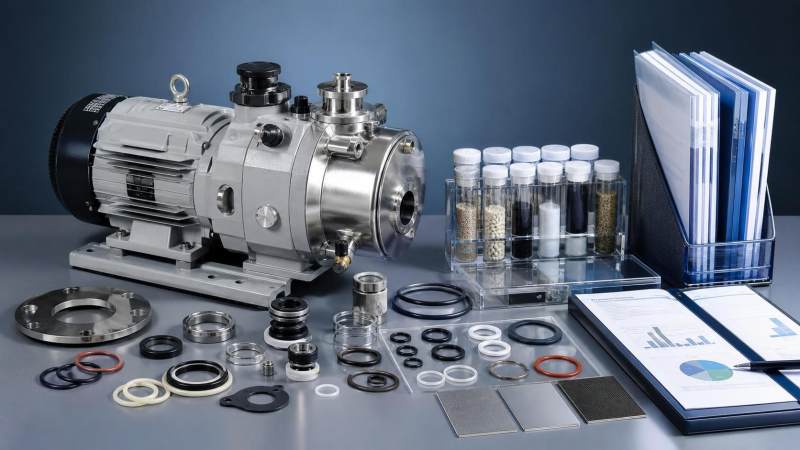
On July 27, 2026, the European Commission issued Regulation (EU) 2026/1893 amending the restrictions on PFAS in elastomeric seals used in vacuum-generating equipment under Entry 77 of Annex XVII to REACH. It also clarified that, starting October 1, 2026, compliance checks will be conducted on complete vacuum pumps and critical sealing components imported into the EU. For vacuum pump exporters targeting the EU market, the key point of this change is not limited to the restriction value itself. Material selection, supply chain traceability, and updates to CE technical documentation will also be subject to more direct compliance review before and after delivery.
What requirements have been clarified by this revision
The confirmed information indicates that, on July 27, 2026, the European Commission officially issued Regulation (EU) 2026/1893, bringing the use of per- and polyfluoroalkyl substances (PFAS) in elastomeric seals used in vacuum-generating equipment under Entry 77 of Annex XVII to REACH.
The revision sets a limit of ≤25ppb, measured as total organic fluorine.
At the same time, starting October 1, 2026, compliance checks will be implemented for complete vacuum pumps and critical sealing components imported into the EU. The information provided also makes clear that this requirement will directly affect material substitution, supply chain traceability, and CE technical documentation updates for Chinese vacuum pump exporters.
The impact will first be felt in materials, delivery, and documentation chains
Complete-unit manufacturers shipping to the EU will face compliance pressure first
From an operational perspective, exporters of complete vacuum pumps will be affected first because the scope of compliance checks clearly covers complete products imported into the EU. Companies need to focus not only on whether the product itself meets the requirements, but also on whether the sources of sealing materials, accompanying shipment documents, technical documentation updates, and internal pre-delivery review procedures can address the new restrictions.
Suppliers of critical sealing components will be subject to earlier review
For suppliers providing elastomeric seals and related critical components, the main impact will be on material compliance certification and traceability capabilities. Since the restriction directly targets elastomeric seals used in vacuum-generating equipment, purchasers and complete-unit manufacturers are more likely to impose clearer requirements concerning material substitution, batch consistency, and traceability documentation during product selection, acceptance, and supplier management. The importance of relevant certificates, testing documents, and supplier declarations will correspondingly increase.
Procurement and supply chain coordination need to be involved earlier
For teams responsible for procurement, supply chain management, and delivery coordination, the direct issue arising from this regulatory change is that existing bills of materials, supplier qualification reviews, and delivery schedules may need to be realigned. Particularly for EU-related projects or orders, procurement teams need to verify whether the sources of sealing materials are clear, whether substitute materials have been included in validation, and whether suppliers can provide the information needed to support technical documentation updates.
The focus of certification and testing services will shift
For certification-related companies, testing service providers, and parties supporting the preparation of technical documentation, this change means that more attention will be placed on the evidentiary basis corresponding to the limit, document consistency, and preparation for compliance checks. Since the information provided specifically mentions CE technical documentation updates, relevant service providers need to assess whether a company’s existing documentation system can fully reflect material changes and their compliance basis.
What practical issues should companies focus on now
First confirm whether affected materials have entered the EU order chain
Based on the analysis, the most practical first step for companies is to review the elastomeric seals used in complete vacuum pumps and critical sealing components, and confirm whether they have already entered EU market orders, EU customer projects, or inventory prepared for the EU market. Only after the affected materials have been identified can subsequent substitution, validation, and documentation updates have a clear target.
Address material substitution and supply chain traceability together
The information provided clearly indicates that material substitution and supply chain traceability will be directly affected, so companies should not handle these two tasks separately. If substitute materials are advanced without simultaneously establishing supplier information, batch origins, and compliance records, gaps may still arise during inspections, customer reviews, or delivery explanations.
CE technical documentation updates must go beyond supplementary explanations
From a practical perspective, since this change specifically points to CE technical documentation updates, companies need to do more than add a supplementary page. They should check whether the content related to sealing material, descriptions of critical components, compliance bases, and supporting documents remains consistent throughout the technical file. For companies that have used existing document templates for a long time, this is often an easily overlooked area.
Pre-delivery reviews need to be moved earlier
The implementation of import compliance checks starting October 1, 2026 means that order planning, inventory preparation, and pre-shipment reviews related to the EU need to begin earlier. Especially for businesses involving the separate supply of critical sealing components or the coordinated delivery of complete units, companies should ensure that document preparation and internal review can be completed before the delivery milestone. Since the information provided does not include more specific implementation details, this should be understood as a reminder to prepare in advance, rather than as a definitive judgment on specific customs clearance or market outcomes.
This is more like a compliance signal entering an execution countdown
From an industry perspective, this information is better understood as a signal that a rule with a clearly specified implementation date is being put into effect, rather than as a development still at the stage of soliciting opinions or discussing general direction. This is because the information provided includes the amending regulation, the provision covered, the limit requirement, and the start date for import compliance checks.
However, the implementation of a rule does not mean that its enforcement approach is already completely transparent. Companies still need to continue monitoring official statements, customer procurement documents, certification requirements, and actual inspection feedback from the market. In particular, in scenarios involving critical sealing components and integrated delivery of complete units, different business chains may reveal requirements for documentation completeness at an earlier stage.
For exporters, the focus has shifted from understanding the policy to preparing evidence
Overall, the industry significance of this change is that, when vacuum pump-related products enter the EU market, the PFAS restriction on elastomeric seals is no longer merely a discussion at the material level. It is beginning to become a compliance requirement directly connected with procurement, delivery, documentation, and traceability. At present, this information is best understood as an execution signal with a defined timetable: companies need both to understand the factual boundaries and to prepare materials, supply chains, and technical documentation within the same review framework as soon as possible.
Basis of this article and directions for further verification
This article was generated based on the information title, event date, and event summary provided by the user. The information used includes: the issuance of Regulation (EU) 2026/1893 on July 27, 2026; the inclusion of the use of PFAS in elastomeric seals used in vacuum-generating equipment under Entry 77 of Annex XVII to REACH; a limit of ≤25ppb, measured as total organic fluorine; and the implementation of compliance checks on complete vacuum pumps and critical sealing components imported into the EU starting October 1, 2026.
For events of this type, continued verification is normally required in conjunction with official announcements, publications by regulatory authorities, information from trade authorities, industry association information, documents issued by standards organizations, and reports from authoritative media. Since no specific official source links were provided in the input, the relevant original texts, implementation details, and supporting explanations still require further verification. Matters worth continued observation include the approach to certification enforcement, changes in technical documentation requirements, adjustments to tender or procurement documents, industry feedback, and the actual implementation by companies.