
News Center
News center

EU CE regulations tightened: pump equipment exports must be accompanied by energy efficiency test reports and EPD certification
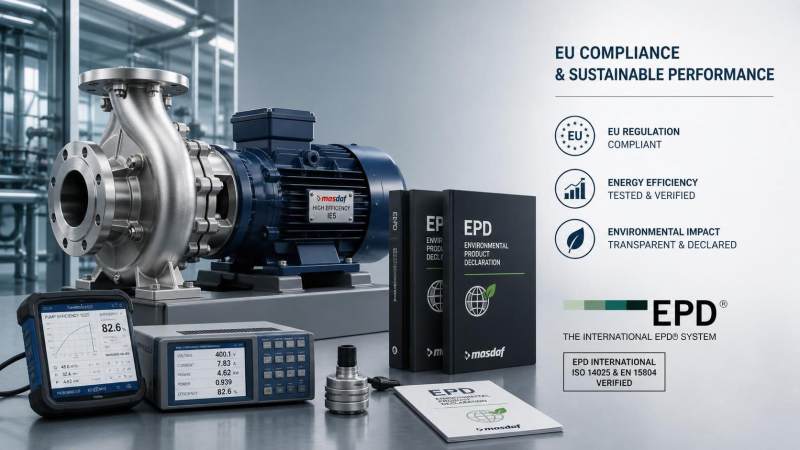
After the European Commission formally implemented the supplementary provisions of
This means that EU market access for pump products is no longer assessed solely on the basis of basic safety and conformity documents. Energy-efficiency performance and environmental information disclosure have also been incorporated into the review process. For exporting companies, the most direct impacts will usually be seen in the preparation of technical documentation, testing schedules, coordination of certification activities, and customs clearance timelines. If the documentation is incomplete, the risk of products being intercepted and returned during EU customs clearance will also increase.
The compliance focus is shifting from “passing inspection” to the parallel requirements of “energy efficiency + environmental declaration”
The latest regulatory changes indicate that the EU’s approach to managing pump equipment is increasingly focused on full-chain compliance. On the one hand, the energy-efficiency test report must be issued by an EU-recognized LAB; on the other hand, the EPD Environmental Product Declaration must undergo third-party verification. The two types of documents correspond respectively to product performance and environmental information. Companies must satisfy both requirements and cannot prepare only one type of testing document.
For Chinese pump manufacturers, the pressure created by these requirements often lies not in any single certificate itself, but in the supporting processes. If testing, verification, declaration preparation, and CE document archiving are not coordinated in advance, delays may occur at the customs declaration stage. Small and medium-sized exporters are particularly affected, as they generally have weaker technical documentation reserves and cross-organization coordination capabilities, making the increase in compliance costs more apparent.
The impact on export schedules and customer deliveries deserves greater attention
Such mandatory documentation requirements generally lengthen the time gap between “the product has completed production” and “the product can be shipped overseas smoothly.” For foreign trade orders, the impact is not limited to the customs clearance efficiency of an individual shipment; it may also affect customer delivery dates, inventory preparation arrangements, and the stability of subsequent orders. If companies continue using their previous documentation preparation methods, delivery certainty in the EU market may decline.
At the industry level, this will also compel companies to move compliance activities forward to the R&D and shipment stages, rather than concentrating on supplementing documents immediately before shipment. For companies with a broad range of product series and frequent model changes, document version management and testing coverage will become part of the actual cost.
What deserves attention next is not the regulation itself, but how it will be implemented
The information currently available already points to clear compliance thresholds. However, the details of implementation often have a greater impact on market operations, including the strictness of customs document verification, the applicable boundaries for different product types, and companies’ transitional arrangements following updates to the standards. Based on this information, pump exporters should pay closer attention to official EU announcements, relevant standards documents, and supporting guidance issued by certification and testing bodies.
Based on the current assessment, the signal conveyed by this change is clear: the EU’s market access management for industrial equipment is extending toward more detailed performance verification and environmental disclosure. For exporting companies, compliance capabilities will increasingly become a basic operational capability rather than merely a temporary customs clearance procedure.