
News Center
News center

The EU REACH has added new SVHCs, increasing compliance pressure on vacuum pump seals
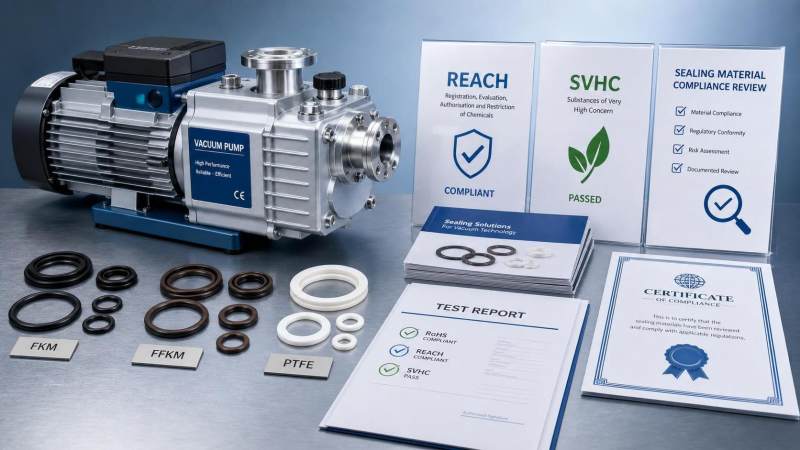
On August 6, 2026, the SVHC Candidate List under the EU REACH Regulation was updated again, and the newly added substances have affected FKM, FFKM, and certain PTFE sealing materials commonly used in vacuum pumps. For vacuum pump complete units and related components intended for the EU market, this is not merely a change to the material list; it also directly affects REACH compliance declarations, SDS updates, importer obligations, and subsequent customs clearance arrangements. Therefore, it deserves the simultaneous attention of exporting companies, purchasers, supply chain service providers, and compliance support institutions.
Confirmed Information on This List Adjustment
According to the information provided, on August 6, 2026, the European Chemicals Agency (ECHA) included three phthalate plasticizers and one fluorine-containing polymer degradation product in the 29th batch of the SVHC Candidate List.
The newly added substances involve fluoroelastomer (FKM), perfluoroelastomer (FFKM), and certain polytetrafluoroethylene (PTFE) sealing components commonly used in the vacuum pump sector. As a result, vacuum pump products exported from China to the EU will face new verification requirements regarding REACH compliance declarations, SDS updates, and importer registration obligations.
The information provided also indicates that, starting in November 2026, if the content of substances of very high concern in a complete unit exceeds 0.1% and the required notification has not been completed, the relevant products may be temporarily held by EU customs during clearance.
The Impact Has Extended from Materials to Complete-Unit Delivery
Vacuum Pump Exporters First Face a Reassessment of Complete-Unit Documentation
The analysis indicates that the parties most directly affected are exporters of complete vacuum pump units shipped to the EU. This is because the change is not limited to a single raw material level but may also extend to complete-unit declarations and delivery documents. Relevant companies need to focus on whether the material composition of sealing components reaches the SVHC threshold and whether their existing REACH declarations, SDSs, and supporting technical documents can still meet export and customs clearance requirements.
Procurement and Supplier Management Need to Move Verification Forward
From an industry perspective, raw material purchasing companies and the procurement departments of complete-unit manufacturers will also be affected. FKM, FFKM, and certain PTFE sealing components are commonly used in vacuum pumps. Once the material information provided by upstream suppliers is incomplete, complete-unit manufacturers may be placed in a passive position in compliance assessment, document updates, and delivery arrangements. The key concerns are not limited to purchase prices and lead times; they also include whether suppliers can provide timely, traceable substance information and updated compliance documents.
Importers and Customs-Clearance Service Providers Face Greater Pressure
The inclusion of importer registration obligations as a specific point indicates that EU-side recipients and supporting supply chain service companies also need to adjust their work schedules accordingly. For parties responsible for importation, customs declaration, warehousing, or delivery coordination, subsequent attention will focus on the completeness of documentation, notification status, and consistency among customs clearance materials. Especially as November 2026 approaches, documentation gaps may directly affect customs clearance efficiency.
Testing and Compliance Support Institutions Will Have a More Focused Workload
For certification companies, testing service providers, and compliance consulting and support organizations, this change means that customer demand will be more concentrated on sealing material screening, document updates, and substance information confirmation. Its impact will mainly be reflected in sample identification, material boundary determination, document matching, and the efficiency of technical communication. Although the input information does not provide more specific implementation details, these service providers are likely to become an important support for companies seeking to address compliance gaps.
Which Practical Areas Should Companies Focus on Now?
First Confirm Whether the Affected Components Fall within the Complete-Unit Compliance Boundary
The analysis indicates that companies should first verify whether the FKM, FFKM, and certain PTFE sealing components used in their vacuum pump products are included in the actual configuration lists of models exported to the EU. The focus of this action is not a general review of material names, but confirmation of whether specific components are incorporated into the complete unit, whether they are involved in EU deliveries, and whether the relevant substance information can support subsequent REACH assessment.
Check Simultaneously Whether REACH Declarations and SDSs Need to Be Updated
The information provided clearly states that REACH compliance declarations and SDS updates will be affected. Therefore, companies need to verify as soon as possible whether the versions of their existing documents remain applicable. For businesses involving regular exports, long-term supply, or framework orders, the timing of document updates deserves particular attention, as outdated documentation may affect customer reviews, procurement approval, or shipment arrangements.
Include Importer Obligations and Notification Status in Delivery Scheduling
The customs-clearance risk indicated for after November 2026 means that companies cannot regard this matter merely as internal work for the laboratory testing or regulatory affairs departments. Of greater concern is that importer registration obligations and the completion status of notifications may in turn affect order production scheduling, shipment windows, and delivery commitments. For EU projects, time for document confirmation and communication should be reserved in the delivery schedule.
Continue Tracking Subsequent Implementation Guidelines and Customer Documentation Requirements
Because the input information does not provide more detailed implementation rules, companies should not yet interpret all consequences as fully determined. A more appropriate approach is to continue tracking subsequent official statements, new customer clauses, updates to tender documents, and changes in import-side documentation requirements, thereby avoiding misjudgments while the applicable rules and interpretations are not yet fully clear.
This Resembles a Clear Implementation Signal
From an industry perspective, this information should first be understood as a regulatory change that has reached the operational level, rather than merely an update to a list at the conceptual level. This is because the information provided has clearly linked the change to sealing materials commonly used in vacuum pumps, REACH declarations, SDSs, importer obligations, and customs-clearance risks after November 2026, indicating that the impact pathway is already relatively clear.
At the same time, this is not a static matter that can be handled once and for all. What still requires attention is how companies define the affected components, how customers adjust procurement documents, how import-side parties conduct document reviews, and whether market feedback further changes delivery schedules. In other words, it is both an implemented compliance change and a dynamic signal requiring continued tracking of implementation requirements.
Practical Implications for Market Participants
Overall, this adjustment to the SVHC Candidate List sends a direct reminder to the vacuum pump industry: material compliance issues are extending to complete-unit compliance, trade documentation, and actual delivery. For exporters, purchasers, importers, and supporting service providers, the more appropriate way to understand this information is to treat it as a compliance requirement that has entered the implementation preparation stage, and to use it as a basis for checking materials, documents, and the customs-clearance chain in advance, rather than waiting until customs clearance to respond passively.
Basis of This Article and Directions for Further Verification
This article was generated based on the information provided by the user, including the information title, event date, and event summary. The core information includes the addition of substances to the SVHC list under the EU REACH Regulation, the event date of August 6, 2026, and descriptions of the impact on sealing materials commonly used in vacuum pumps, REACH declarations, SDS updates, importer obligations, and customs-clearance risks after November 2026.
For events of this type, continued verification is normally required by consulting official announcements, publications issued by regulatory agencies, information from customs or trade authorities, industry association information, documents issued by standards organizations, and reports from authoritative media. Since no specific official source links were provided in the input, this article cannot be further matched to specific original documents. Continued attention is still required regarding official detailed rules, certification and compliance implementation requirements, changes to tender documents, industry feedback, and actual implementation by companies.