
News Center
News center

New EU CE Regulation Takes Effect: Vacuum Pumps Must Bear Digital Compliance Labels
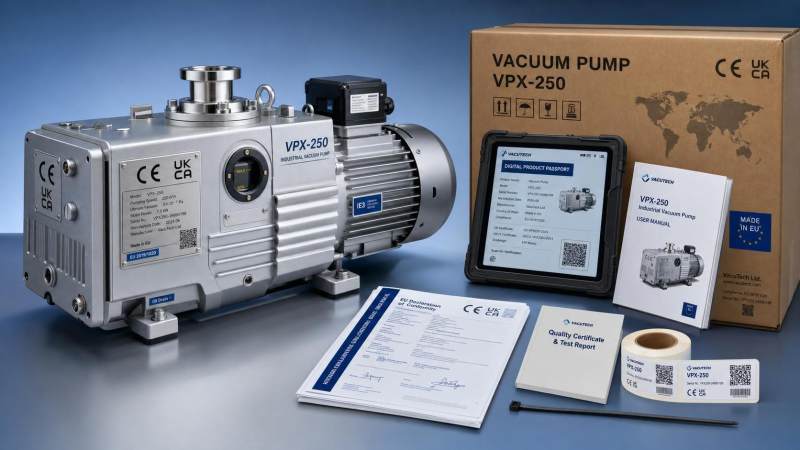
On July 29, 2026, clear changes emerged in the compliance requirements for vacuum pump equipment entering the EU market. According to the information disclosed, the EU officially implemented the amendment to Regulation (EU) 2023/1238. Vacuum acquisition equipment entering the EU market must be provided with a unique digital compliance label on the product itself and in electronic documentation, and the relevant information must be uploaded simultaneously to the EU Product Compliance Portal. This change deserves particular attention from export manufacturers, traders, certification coordination service providers, and after-sales service teams, as it is now directly linked to customs clearance, market access, and subsequent traceability arrangements.
What specific changes are introduced by the requirements that have taken effect?
The confirmed information indicates that, from July 29, 2026, the EU will officially implement the amendment to Regulation (EU) 2023/1238. The requirements apply to vacuum acquisition equipment entering the EU market, including rotary vane pumps, Roots pumps, and molecular pumps.
The requirements clearly stipulate that the relevant equipment must be mandatorily affixed with a unique digital compliance label on the product itself and in electronic documentation, namely the Digital Product Passport, DPP, and that the information must be uploaded simultaneously to the EU Product Compliance Portal.
The confirmed result is that this requirement will directly affect the customs clearance, market access, and after-sales traceability capabilities of Chinese exporters. Products that fail to meet the compliance requirements may be refused entry or face delisting penalties after entering the market.
Which business processes will be affected first?
Compliance preparation before export shipment is being moved forward
From an industry perspective, export companies shipping directly to the EU will feel the impact first, because the new requirements are no longer merely a traditional product-labeling issue. They involve three areas at the same time: the product itself, electronic documentation, and portal uploads. For these companies, before shipment, particular attention must be paid to whether the label is unique, whether the electronic materials correspond with it, and whether the documentation related to EU market access is complete. If these processes are not properly coordinated, the risks will be directly reflected in customs clearance and delivery.
Manufacturing and assembly processes need to ensure consistency between labels and documents
For vacuum pump manufacturers and processing and assembly operations, the impact is mainly concentrated on product identification management before shipment and the organization of technical materials. Since the requirements cover both the product itself and electronic documentation, companies need to pay attention to information consistency during production, packaging, and the preparation of shipping documents. This change may turn the previously dispersed work of labeling, documentation, and export material preparation into a more closely connected compliance chain.
Pressure on channel sales and after-sales traceability is increasing
Channel distribution companies and after-sales service providers selling related equipment in the EU market also need to monitor the regulatory changes. This is because the requirements are now clearly linked to after-sales traceability capabilities. In other words, whether the relevant identification and electronic information can be verified after the product enters the market will affect subsequent sales management and the coordination of after-sales services. Channel operators need to pay greater attention to the compliance status of their sources, while after-sales teams need to focus on product identification, document retrieval, and traceability coordination.
The work of certification and testing coordination services is becoming more execution-oriented
Certification companies, testing service providers, and supply chain service companies will also be affected. Although they do not directly determine whether a product can enter the market, they may take on more support responsibilities in document preparation, compliance verification, delivery coordination, and information upload assistance. For these participants, greater attention should be paid to whether customer requirements for certificates and documents, electronic documentation, compliance information matching, and delivery timing are becoming more stringent.
What practical changes should companies focus on now?
First verify the applicable product categories and current orders
For companies already supplying or preparing to supply the EU market, the first priority is to verify whether their products fall within the scope of vacuum acquisition equipment covered by these requirements, with particular attention to current orders, stocked products, and pending projects involving rotary vane pumps, Roots pumps, molecular pumps, and other products. Since the rules have taken effect, existing and newly added business can no longer be managed solely according to previous practices.
Check product identification and electronic documentation simultaneously
Companies need to focus not only on the digital compliance label on the product itself, but also on whether the electronic documentation has been configured accordingly. Since the input information does not provide more detailed implementation criteria, specific operational details cannot currently be treated as established conclusions. However, it is clear that consistency between product identification and electronic documentation has become a priority item for companies to verify.
Pay attention to the impact of portal uploads on delivery schedules
The confirmed requirements include simultaneous uploading to the EU Product Compliance Portal. This means that companies need to incorporate the upload process into their internal procedures for shipment, customs clearance, and delivery preparation. The issues that deserve further attention are who will be responsible for the upload, when it will be completed, and how the upload will be coordinated with shipping documents. These execution-related issues may affect actual delivery schedules, although the specific requirements still need to be further verified.
Incorporate traceability capabilities into after-sales and trade risk management
As these changes clearly involve after-sales traceability capabilities, exporters, distributors, and after-sales service providers need to incorporate compliance label and electronic document management into subsequent risk control. Key areas of concern include whether delivery documents can be easily verified later, whether product information can be quickly matched during after-sales service, and whether non-compliance risks may extend to trade issues such as returns, delisting, or customer claims. This should be understood as advance risk management rather than an assumption that a uniform market enforcement outcome has already occurred.
This is more like a signal that implementation is moving into the execution stage
This information is better understood as a market access change that has already entered the implementation stage, rather than a development still limited to consultation or a statement of principle. This is because the effective date, applicable product categories, labeling requirements, portal upload obligations, and consequences of non-compliance have all been clearly mentioned.
At the same time, this does not mean that all implementation details are already fully clear. The industry should continue to monitor more detailed certification criteria, documentation requirements, the actual focus of inspections, whether tender documents or procurement requirements are updated accordingly, and feedback from market participants regarding implementation. For companies, the more practical approach now is not to wait and see whether the rules will be implemented, but to promptly review and organize internal processes around the requirements that have already taken effect.
The implications for vacuum pump export business are becoming more specific
Based on the confirmed information, the entry into force of these new EU CE-related regulations does not point to an abstract compliance trend. Instead, it introduces more specific digital labeling and information upload requirements for vacuum pump equipment entering the EU market. Their impact on export, manufacturing, distribution, and after-sales processes is mainly concentrated on access verification, document consistency, delivery coordination, and traceability management.
At present, this information is best understood as a compliance threshold change and implementation signal that has already taken effect. The subsequent enforcement scope, the pace at which companies adapt, and market feedback will still need to be monitored continuously in light of further disclosed regulatory details and actual operating conditions.
Basis of this article and directions for further verification
This article was generated based on the information title, event date, and event summary provided by the user. The confirmed facts discussed are limited to the information contained in that input. For events of this type, cross-verification is generally also required using official announcements, releases from regulatory authorities, information from customs or trade authorities, industry association updates, documents from standards organizations, and reports from authoritative media.
It should be noted that no link to a specific official source was provided in the input, so this article does not cite a specific link. Matters that still require ongoing verification include whether policy details will be further clarified, whether supplementary certification criteria will be issued, whether tender documents and procurement requirements will change accordingly, and whether industry feedback and company implementation will produce clearer market signals.