
News Center
News center

EU Ecodesign Regulation Takes Effect on August 1: Vacuum Pump Energy Efficiency Requirements Raised
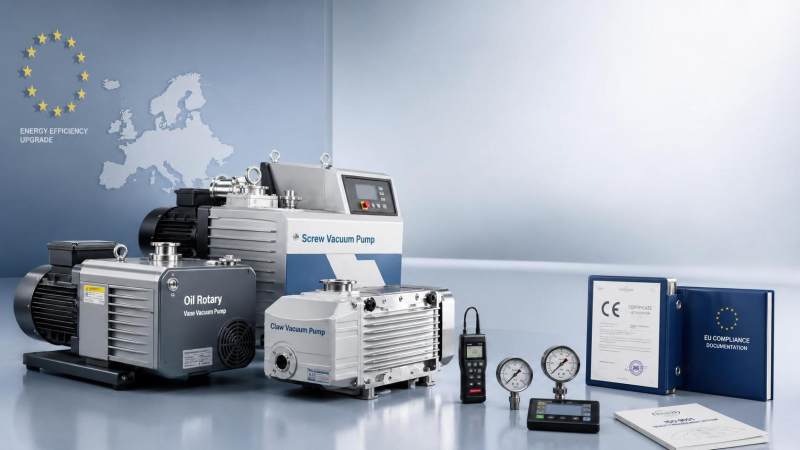
As of August 1, 2026, the EU's new Ecodesign Regulation (EU) 2026/1247 will officially enter the implementation phase, and vacuum pumps will be included in the scope of mandatory energy efficiency rating management for the first time. For vacuum pump exports to the EU market, this change involves more than adjustments to product parameters; it will also directly affect compliance reviews, the use of energy efficiency labels, testing and certification arrangements, and delivery schedules. It will have a practical impact particularly on the manufacturing, procurement, export, and supporting service processes for related equipment such as rotary vane, screw, and claw vacuum pumps.
Clearly Defined Elements of This Regulatory Change
According to the information provided, an announcement by the European Commission indicates that the new Ecodesign Regulation (EU) 2026/1247 will officially enter into force on August 1, 2026.
The regulation will, for the first time, include vacuum pumps in the scope of mandatory energy efficiency rating management, covering vacuum pump equipment such as rotary vane, screw, and claw types.
Vacuum pump equipment exported to the EU will need to meet the minimum IE3 energy efficiency limit and bear the new energy efficiency label.
The summary provided also indicates that this change will directly affect the compliance pathways, testing and certification cycles, and delivery windows of Chinese vacuum pump export companies.
The Initial Impact Will Be on Compliance, Delivery, and Transaction Coordination
Export Manufacturers Will First Face Changes in Market Access Conditions
From an industry perspective, vacuum pump manufacturers and companies directly engaged in exports will be the first to come under pressure. The reason is that products previously able to enter the EU market will now need to meet both the minimum energy efficiency limit and the new labeling requirements. The business impact will not be limited to the products themselves but will also extend to the preparation of technical documents, pre-shipment compliance confirmation, and assessment of whether the models specified in orders can be delivered as required.
The key issues these companies currently need to focus on are whether their existing export models fall within the scope of the new regulation, whether they can meet the minimum IE3 energy efficiency requirement, and whether the technical documents, labeling materials, and compliance statements provided to customers need to be updated accordingly.
Procurement and Project Execution May Involve Preliminary Reviews
For purchasers, project integrators, and distribution channels, the impact of the regulatory change will be reflected more in product selection and ordering conditions. Analysis indicates that once vacuum pumps are included in mandatory energy efficiency rating management, procurement decisions will no longer focus only on price, lead time, and operating-condition compatibility; confirmation of the energy efficiency rating and label compliance will also be required.
This means that procurement plans, technical agreements, supplier qualification requirements, and delivery document lists involving the EU market may all need to be reviewed against the IE3 threshold and the new labeling requirements. If preliminary confirmation is insufficient, delays may subsequently occur in delivery coordination or acceptance documentation.
Testing, Certification, and Supply Chain Services Need to Align with the New Timing Requirements
For testing service providers, certification-related companies, and supply chain service providers, the direct impact of this change lies in business scheduling. The summary clearly states that testing and certification cycles and delivery windows will be affected. This means that shipment arrangements, pre-customs-clearance document preparation, and customer delivery commitments will all depend more heavily on whether preliminary testing and compliance procedures proceed smoothly.
In practice, all service providers involved in export support will need to pay greater attention to the completeness of companies' testing reports, technical documents, label information, and compliance certification materials, because these items will have a more direct impact on whether orders can proceed within the established timeframe.
Several Practical Points That Require Close Attention
First Confirm Whether the Products Fall within the Scope of This Regulatory Framework
Companies should first review their own export models, with particular attention to equipment in categories such as rotary vane, screw, and claw vacuum pumps. Analysis indicates that determining whether a product falls within the scope of this regulatory framework is a prerequisite for subsequently arranging testing, labeling, and delivery.
Move Compliance Documentation Preparation to the Front End of the Shipment Process
From a practical operations perspective, the minimum IE3 energy efficiency limit and the new energy efficiency labeling requirements mean that technical documents, test results, label content, and customer document coordination need to be completed earlier. What currently deserves particular attention is whether the relevant materials can remain consistent with customer procurement documents, contractual requirements, or delivery documentation, as this will directly affect the efficiency of order execution.
Allow Buffer Time for Testing, Certification, and Delivery Scheduling
The information provided has already made clear that testing and certification cycles and delivery windows will be affected. Therefore, when arranging export orders, companies should treat certification, testing, and document confirmation as part of delivery schedule management rather than as procedures to be completed just before shipment. Scheduling should be handled with particular care for existing EU-market projects and newly signed orders.
Continue Monitoring Subsequent Implementation Guidance
Since the input does not provide more detailed implementation information, companies should not currently regard all implementation outcomes as fully established. A more prudent approach is to continue following subsequent official statements, certification implementation guidance, changes in customer tender documents, and actual market feedback, thereby avoiding excessive conclusions based solely on summary information.
This Appears More Like a Clear Implementation Signal
In practical terms, this news is more appropriately understood as a signal that the regulation has entered the implementation stage, rather than as a policy development remaining at the discussion stage. The reason is that the confirmed information already includes the effective date, applicable product categories, minimum energy efficiency requirements, and labeling requirements. These elements are sufficient to affect companies' compliance assessments for EU-market orders.
At the same time, it should be recognized that the input information does not provide more detailed implementation rules, differences in interpretation, or market feedback. Therefore, the industry's current understanding of this new regulation should remain at the level that a clear direction has emerged, while specific implementation still requires ongoing verification. For companies, the actual risk may not necessarily come from the regulation itself, but from insufficient preparation for the pace of implementation and documentation requirements.
The Main Industry Significance Lies in the Earlier Application of Market Access Thresholds
Overall, the EU's inclusion of vacuum pumps in mandatory energy efficiency rating management conveys a core message: energy efficiency requirements are becoming one of the actual market access conditions for vacuum pump exports to the EU. For companies, this is not merely the addition of a labeling task; it also links product design, testing and certification, document preparation, and delivery arrangements more closely together.
At present, it is more appropriate to understand this news as a compliance change that has already entered implementation, as well as a starting point for continued observation of subsequent implementation details, procurement document adjustments, and market feedback. What industry participants need to focus on next is not a general discussion of the regulation's impact, but whether their own business processes can promptly align with these requirements.
Basis of This Article and Directions for Further Verification
This article was generated based on the information provided by the user, including the news title, event date, and event summary. The key bases include “EU Ecodesign Regulation Takes Effect on August 1: Mandatory Upgrade of Vacuum Pump Energy Efficiency Ratings,” the event date “2026-08-01,” and summary information concerning the implementation of the Ecodesign Regulation (EU) 2026/1247, the inclusion of vacuum pumps in mandatory energy efficiency rating management, the minimum IE3 energy efficiency limit, and the new energy efficiency labeling requirements.
For this type of industry news, subsequent verification generally still needs to combine official announcements, releases from regulatory authorities, information from trade authorities, industry association information, documents from standards organizations, and reports from authoritative media. Since no specific official source link was provided in the input, this article does not cite a specific link. The relevant official texts, implementation details, and interpretation guidance still require further verification.
The areas worth continuing to monitor include whether the policy details will be further clarified, whether certification implementation guidance will be refined, whether tender and procurement documents will be adjusted accordingly, whether industry feedback will focus on testing cycles and delivery arrangements, and how companies adapt during actual implementation.